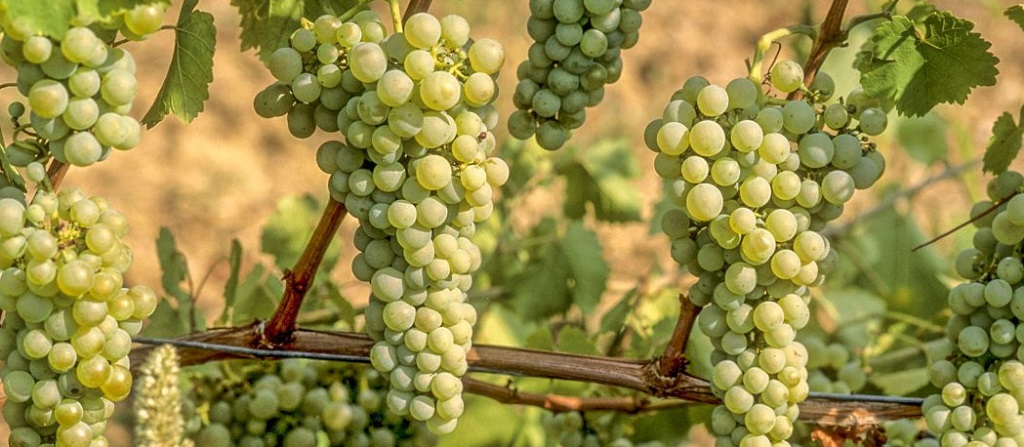
Aidani is a white grape variety native to the Greek islands, most commonly found on Santorini. It is valued for its floral aromatics, soft texture, and ability to balance the more structured and mineral driven Assyrtiko. While rarely bottled on its own, Aidani plays an important role in traditional blends and is essential to the production of Santorini’s historic Vin Santo.
Aidani has been grown for centuries on the Cycladic islands, especially Santorini, where it forms part of the island’s traditional white blend. Its origins are unclear, but historical references place it among the indigenous varieties used in local wine production. While it has rarely achieved the acclaim of Assyrtiko, Aidani has remained important due to its aromatic lift and contribution to balance. It has traditionally been grown alongside other native varieties and trained in low basket shapes to protect against the island’s harsh climate.
DNA profiling has confirmed Aidani as a distinct native variety, although its precise genetic relationships to other grapes remain largely unexplored. It is often listed as Aidani Aspro to distinguish it from the less common Aidani Mavro, a dark skinned version. Outside of Santorini, it may be found in smaller quantities on islands such as Paros and Naxos. The name is consistently spelled Aidani in modern Greek transliteration, though older texts may use variations like Aedani or Aedano.
Aidani ripens late and prefers warm, dry conditions with good sun exposure. It is moderately vigorous and requires careful canopy management to avoid shading and uneven ripening. On Santorini, it is usually trained in the traditional kouloura system, a basket shape that protects the fruit from wind and sun. The variety is moderately productive and relatively disease resistant, making it well suited to low input viticulture. It is less acid driven than Assyrtiko and tends to produce rounder, softer wines, which is why it is typically used as a blending partner.
Aidani responds well to cool fermentation in stainless steel, which helps preserve its floral and stone fruit aromas. It is rarely aged in oak and is most often used to round out the structure of Assyrtiko based blends. In the cellar, it brings body, softness, and perfume to wines that might otherwise be sharp or angular. In the production of Vin Santo, Aidani contributes glycerol richness and aromatic complexity to the dried grape blend. When vinified on its own, it can make charming, lightly textured white wines with gentle acidity and notes of white flower and melon.
Aidani produces dry white wines with soft texture and perfumed aromas. Common flavour notes include jasmine, apricot, melon, and ripe pear. It lacks the tension and minerality of Assyrtiko but compensates with charm and approachability. On its own, it is best consumed young, when its floral character is most vivid. In blends, it supports the structure of more assertive varieties. As part of Santorini’s Vin Santo, it adds richness, dried fruit character, and a rounded finish.
Interest in Aidani is growing alongside the broader reappraisal of Greek native varieties. As producers continue to explore single varietal expressions, Aidani is being given more attention in both dry and sweet styles. A small number of wineries are beginning to bottle it on its own to highlight its aromatic appeal. Outside of Santorini, it is planted in small quantities in other Cycladic islands and parts of Crete. While it remains a niche grape, Aidani is benefiting from the wider global enthusiasm for indigenous Mediterranean varieties.
Some of the most expressive examples of Aidani come from producers such as Hatzidakis, who crafts a varietal wine showing pure floral and stone fruit character with gentle freshness. Gavalas Winery also makes a clean, unoaked Aidani with subtle spice and a soft finish. In blends, Aidani appears frequently alongside Assyrtiko and Athiri in wines from producers like Argyros and Sigalas. These blends balance structure with aromatics and often represent the traditional Santorini style. In Vin Santo bottlings, Aidani’s presence helps soften the edges of dried Assyrtiko and bring layered richness to these long aged wines.